
Hair Clipper Quality Control: A Wholesale Buyer’s Checklist
An attractive sample can start a business relationship. A repeatable specification and a clear inspection plan help support it. For wholesale buyers, product quality includes cutting behavior, charging, handling, accessories, and consistency between the approved sample and the delivered order.
Rather than asking only whether a supplier performs quality control, ask what is checked, under which conditions, and how results are linked to your selected model. The following checklist can guide that conversation with GENTANT or form part of your own sample review.

Begin with an Approved Specification
Record the model, motor type, blade materials, battery, charging arrangement, accessories, color, and packaging. Keep an approved reference sample or documented reference configuration where appropriate.
For a combo, list each device separately. A clipper, trimmer, and foil shaver can have different batteries, charging times, cleaning instructions, and performance requirements. The outer box should not hide those distinctions.
A specification change needs review. Substituting a motor, battery, coating, or adapter can affect function and documentation even if the housing looks unchanged.
Inspect Appearance and Assembly
Look for housing gaps, loose parts, sharp edges, finish inconsistencies, and incorrect markings. Check that blades, switches, displays, and levers match the approved configuration.
Assess operation rather than appearance alone: the lever should move as intended, switches should be accessible, and combs should engage securely. Inspect the charging base for stability and the tool for reliable seating.
Agree whether checks apply to every unit or a defined sample. Sampling methods, acceptance criteria, and defect categories should be settled before inspection, rather than inferred from the phrase “strict QC.”
Evaluate Cutting and Blade Alignment
Use representative hair and a consistent procedure. Check for snagging, pulling, uneven cutting, vibration, and changes in sound. Test the guide combs and length settings the intended customer will actually use.
A high RPM figure does not prove a tool will remove bulk cleanly. Blade condition, drive transmission, motor control, and the chosen feed rate all affect the result. Do not compare one tool’s no-load claim with another tool’s cutting performance.
Where zero-gap adjustment is supported, inspect alignment after following the model’s instructions. A close setting should not be approved solely because it produces a sharp outline in a photograph.
Check Heat, Noise, and Handling Under Defined Conditions
For useful comparisons, record operating duration, speed setting, blade lubrication, ambient conditions, and the cutting task. An unexplained claim that a blade is “cooler” provides little purchasing guidance.
Noise comparisons also need consistent measurement distance and surroundings. Grip comfort and balance should be reviewed by intended users, particularly for repeated barber services. A textured housing should not automatically be advertised as anti-slip in all conditions.
Follow product instructions during evaluation and stop using a tool if it becomes uncomfortable or appears unsafe. An informal sample trial is not a substitute for applicable safety testing.
Verify Battery and Charging Behavior
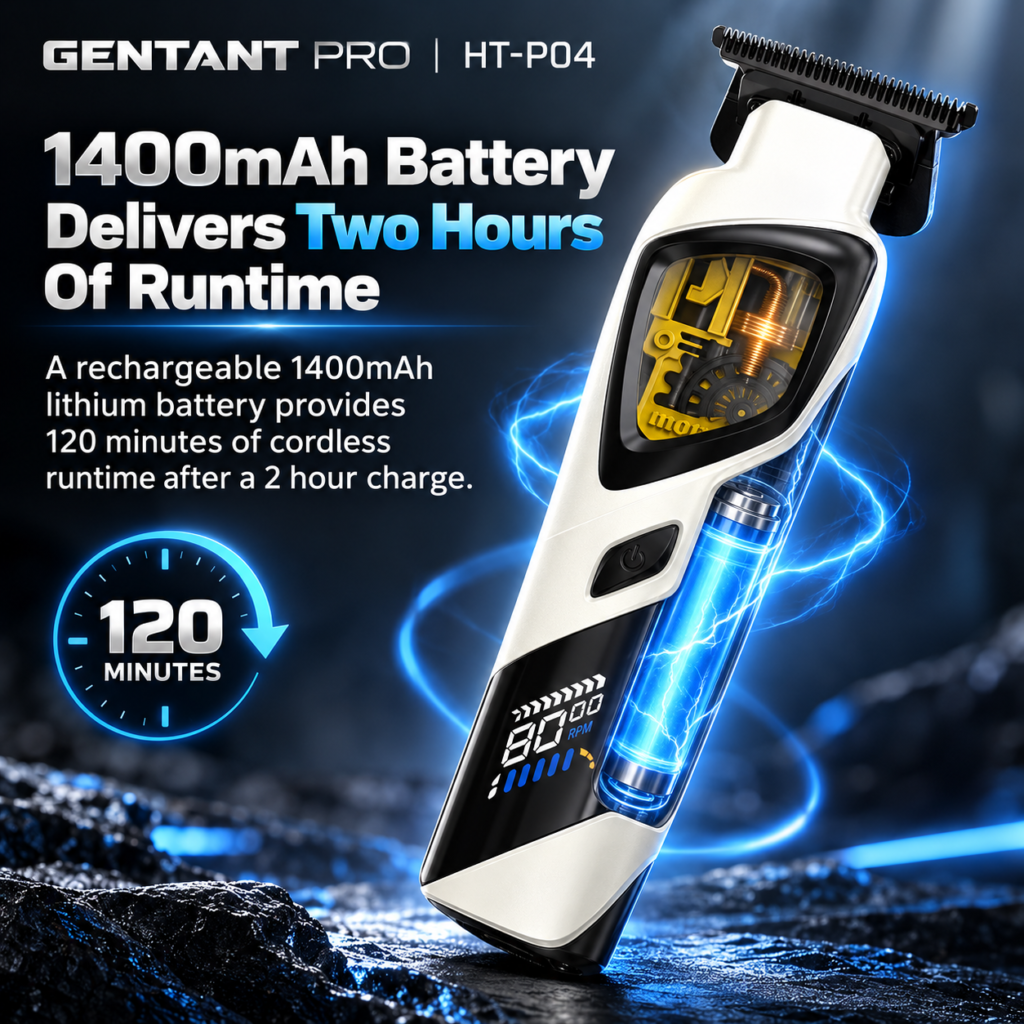
Check the supplied cable and power configuration, charging indicators, connector fit, and any charging stand. Confirm whether runtime was measured with or without a cutting load and at which speed.
The GENTANT HC-E09 specification lists a 3,200mAh battery, approximately 150 minutes of runtime, and approximately 4.5 hours of charging. HT-E01 lists a 2,000mAh battery, approximately 150 minutes of runtime, and approximately three hours of charging. Similar runtime claims do not mean the batteries or operating conditions are identical.
USB-C describes the connection. It does not alone establish USB Power Delivery, a particular wattage, or a fast-charge function. Confirm the required input and compatible power supply for the order.
Check Packaging, Traceability, and Documents
Count all included items, inspect protection around blades, and review labels and manuals. Agree how the model and production batch will be identified and what records will support a later investigation.
Our company is ISO 9001 certified. That concerns the quality management system; it does not replace product-specific conformity evidence. ISO’s explanation of certification distinguishes certification of products, services, and systems. Product reports should match the applicable model, configuration, and destination requirements.
Agree on What Happens If an Issue Is Found
Before shipment, define how nonconforming items will be recorded, reviewed, corrected, and reinspected where necessary. For after-sales cases, agree on the evidence required, reporting route, spare parts, and warranty terms.
Useful reports include the model, batch where available, operating conditions, photographs or video, and a clear description of the issue. That makes it easier to distinguish a component fault from incorrect charging equipment, blade adjustment, or maintenance.
Make Quality Requirements Part of the Order
GENTANT works with buyers on grooming product specifications and inspection requirements for wholesale and customization projects. Share your intended market, acceptance criteria, and documentation needs at the inquiry stage. A clear quality agreement is more useful than a broad promise that every product is “the best.”